





 All Insights
There Is No Single AI Strategy for Software
Enterprise software is said to be facing an adapt-or-die moment.1
Companies will “agentify,” the argument goes, replacing their static interfaces and basic automation with Agentic AI. Or they won’t, and more capable tools from leading model providers will displace them.
Down one path, the potential for another exponential phase of growth. Down the other, obsolescence.
There’s no question that AI is creating new pressure for enterprise software companies, and we believe “agentification” has become the market’s prescribed response. But what that means in practice is broader than the term suggests. Software has more than one path to harnessing AI, each with distinct opportunities to build and compound value over time.
Path One: Product Transformation, or The Revenue Opportunity
Historically, software supported operational workflows, but it did not perform them. A human was in the driver’s seat.
Agentic AI executes work itself. These systems reason, make decisions and carry out multi-step workflows without human intervention.
Some enterprise software companies are now agentifying their products, re-architecting them to perform work autonomously. This is a technological transition, but also an economic one.
Previously, the value of enterprise software was always capped by the number of people using it. Agents have no such constraint. They can work 24 hours a day, 7 days a week, and spawn sub-agents to scale their production exponentially over time. This challenges the logic of the traditional seat-based pricing model. When software is agentified, its economics can scale with the amount of work performed, rather than just the number of users.
Under this new model, software may for the first time capture budgets historically allocated to labor and services, which can significantly expand the category’s addressable market. We believe this is the revenue opportunity for enterprise software.
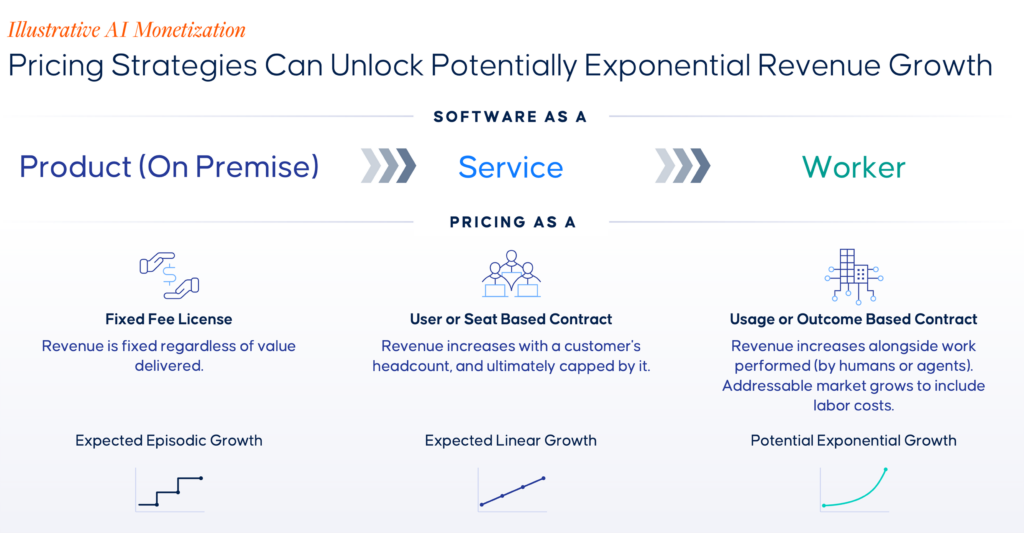
There can be no assurance that the method illustrated above, or similar methods will be effective or have the illustrated outcome. There is no guarantee that AI will be used in any such capacities. The use of generative AI technology presents certain risks including, but not limited to, the risk the technology generates hallucinations and/or inaccurate information.
“The Agentic AI era is here, and it will likely prove to be the most valuable chapter in software’s history.”
Robert F. Smith
Founder, Chairman & CEO of Vista Equity Partners
Path Two: Operational Transformation, or The Margin Opportunity
Not every enterprise software company is well suited to directly agentify its products, or at least not immediately. But contrary to the adapt-or-die framing, they need not miss out on the opportunity for AI-led value creation.
We believe companies can embed AI within their own operations to help improve how efficiently they analyze data, respond to customer needs, and launch products. Software development, long constrained by the cost and scarcity of engineering talent, is being reshaped by generative AI and code-assist tools.
In Vista’s portfolio, teams that adopt AI effectively are bringing new features to market and meeting customer demands faster. The result can be a more efficient cost profile, with gains that may compound as AI capabilities mature and adoption expands. We believe this represents a meaningful margin opportunity for enterprise software.
Which Path Is Right for Your Business?
We believe different paths to AI-led value creation are not mutually exclusive. Many enterprise software companies can expand their addressable markets while improving margins and operational efficiency.
But many businesses are asking where to focus first. A few practical considerations we believe help guide that decision:
- How agentifiable is the workflow? Products built around repeatable, multi-step processes with clear objectives and decision points are better suited to agentification than those that primarily provide information or infrastructure.
- Do you have the context to support autonomy? Agents need access to the underlying customer data, business rules, workflow history, and system permissions required to make reliable decisions and take action. Companies that already own this context are better positioned to agentify their products.
- How much human judgment does the work require? Some workflows can tolerate substantial autonomy today; others still require frequent human review. The more consequential or ambiguous the decisions, or the greater the regulatory exposure, the harder it may be to agentify.
- Are you ready for the economic transition? Moving beyond seat-based pricing requires a clear understanding of customers’ willingness to adapt to a new economic model and a reliable way to meter the work agents perform. Companies should have both in place before changing how they monetize their products.
The Case for Software
Enterprise software has weathered periods of technological dislocation before, such as the transition from on-prem to cloud. Each time, the category has emerged stronger. We believe this cycle will be no different.
We believe that today, software businesses may have several promising ways to build and compound value in an AI-driven market. Genuine displacement risk may be concentrated among companies with shallow customer data and generic solutions, not those entering this transition from a position of strength.
Across Vista’s portfolio, these opportunities have already taken shape. Enterprise software businesses like Duck Creek, Sonatype and Nexthink are seeing accelerating annual recurring revenue (ARR) growth and greater research and development (R&D) efficiency as they adopt AI.
For a closer look at these case studies and the lessons they offer other software businesses, read our full report, Software’s Transition to Agentic Enterprise AI.



CNBC: Ashley MacNeill on AI Driving Software Growth Despite Market Volatility