






The State of Wealth Management AI Adoption
A comprehensive view of AI in wealth management: how firms are adopting, governing and scaling AI, in partnership with Cerulli Associates.
How Wealth Management Is Putting AI To Work
1. State of Wealth Management AI Adoption. Cerulli Associates and Vista Equity Partners, September 2026. Reflects findings from the State of Wealth Management AI Adoption and is not indicative of Vista's views or opinions.
2. Cerulli Associates; 2026 AI in Practice Benchmarking Study. As part of the study, firms self-assess across three pillars: (I) governance and readiness, (II) operational efficiency, and (III) innovation and revenue. The Vista AI Maturity Score is a 0–100 composite built on the weighted scores of the aforementioned pillars using a proprietary Vista model and rescaled to produce a firm-level AI maturity score. Firms fall into three tiers: Leading (above 60), Scaling (30–60), and Exploring (below 30), providing a common benchmark for measuring their AI readiness and implementation against peers.
Key Findings3
AI will augment, not replace, advisors, enabling firms to expand service capacity while maintaining fee levels.
Firms expect to add client-facing headcount over the next two years, with 73% planning to add junior advisors, 67% client associates and 56% senior advisors. Firms are automating administrative work and redirecting that capacity toward deeper client relationships and the human element of advice.
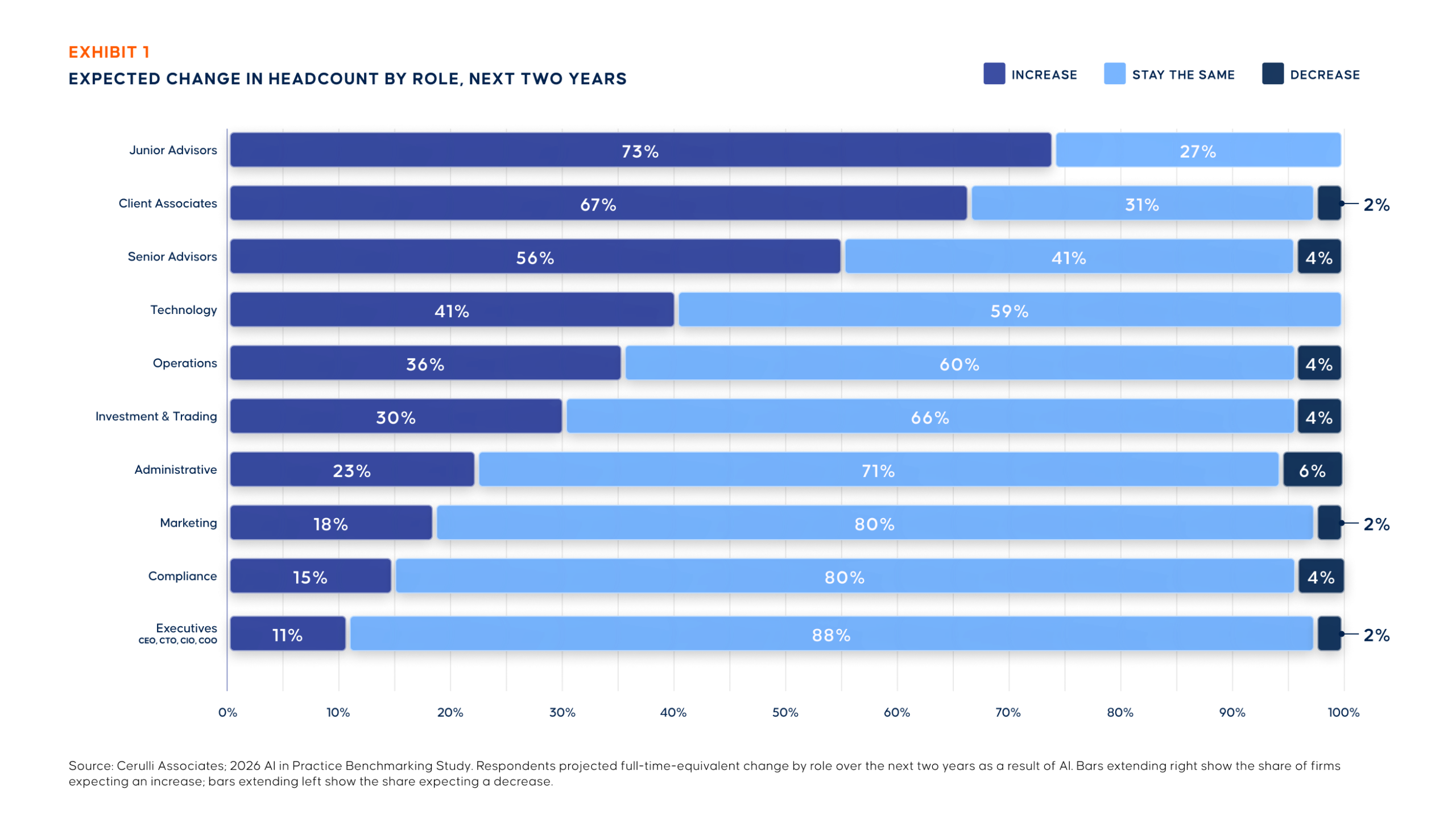
Expected change in headcount by role over the next two years. Share of wealth management firms expecting an increase: junior advisors 73%, client associates 67%, senior advisors 56%, technology 41%, operations 36%, investment and trading 30%, administrative 23%, marketing 18%, compliance 15%, executives 11%. Source: Cerulli Associates, 2026 AI in Practice Benchmarking Study.
A clear divide is opening between firms on AI maturity.
A small group of AI leaders (12%)4 has pulled meaningfully ahead and what sets them apart is their operating framework, including a defined governance model, named ownership, effective training and measurement. These are organizational decisions, not technology investments, which is why AI maturity varies more by operating discipline than by a firm’s AUM or technology spend.
Vista AI Maturity Score Tiers
- Exploring – AI is in use, but largely unmanaged. These firms typically lack a written acceptable use policy, a named owner or structured staff training, and data is not yet organized enough to support AI reliably. Usage tends to be individual rather than firm-wide, and few can point to a measurable result.
- Scaling – The foundation is in place and AI is working in production. Policy, ownership and vendor controls are established or underway, and advisors use AI regularly for notetaking, client communications and meeting prep. Measurement is the common gap: efficiency gains are real but not consistently tracked.
- Leading – Governance, data readiness and training are fully implemented, and AI is embedded across advisor and back-office workflows. These firms track AI’s productivity impact, can point to service expansion or revenue outcomes and view AI capability as a driver of enterprise value.
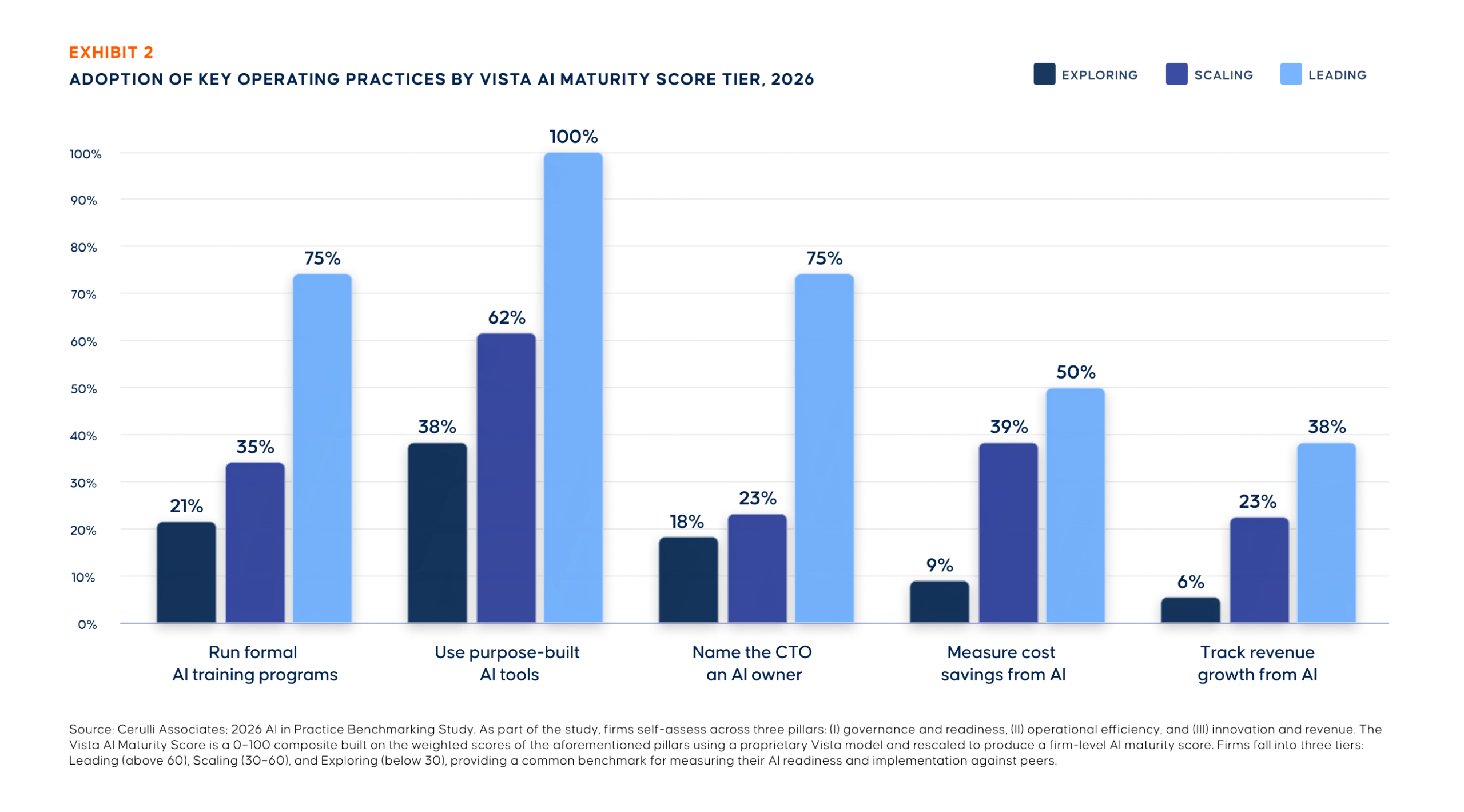
Adoption of key operating practices by Vista AI Maturity Score tier, 2026. Formal AI training programs: Exploring 21%, Scaling 35%, Leading 75%. Purpose-built AI tools: 38%, 62%, 100%. CTO named as AI owner: 18%, 23%, 75%. Measure cost savings from AI: 9%, 39%, 50%. Track revenue growth from AI: 6%, 23%, 38%. Source: Cerulli Associates, 2026 AI in Practice Benchmarking Study.
AI budgets are growing, but firms are spending selectively.
AI-specific spend is projected to roughly double by the end of 2026, rising on average from 8% to 15% of the technology budget. Two-thirds of firms expect to source AI capabilities from a mix of existing partners and specialized AI tools.
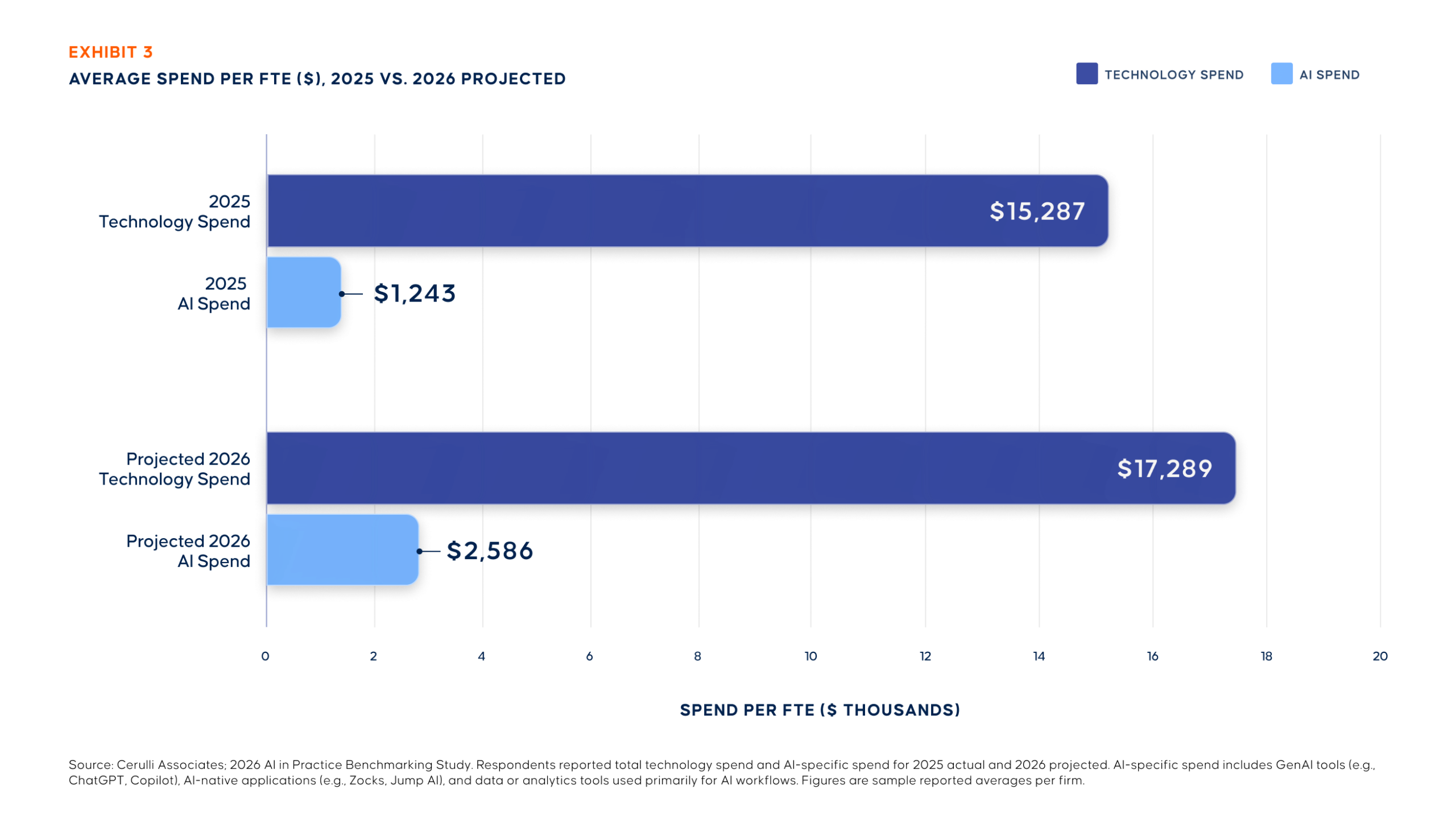
Average spend per full-time employee, 2025 versus 2026 projected. Technology spend $15,287 in 2025 and $17,289 projected for 2026. AI spend $1,243 in 2025 and $2,586 projected for 2026. Source: Cerulli Associates, 2026 AI in Practice Benchmarking Study.
3. Source: State of Wealth Management AI Adoption. Cerulli Associates and Vista Equity Partners, September 2026. Reflects findings from the State of Wealth Management AI Adoption and is not indicative of Vista’s views or opinions.
4. Cerulli Associates; 2026 AI in Practice Benchmarking Study. As part of the study, firms self-assess across three pillars: (I) governance and readiness, (II) operational efficiency, and (III) innovation and revenue. The Vista AI Maturity Score is a 0–100 composite built on the weighted scores of the aforementioned pillars using a proprietary Vista model and rescaled to produce a firm-level AI maturity score. Firms fall into three tiers: Leading (above 60), Scaling (30–60), and Exploring (below 30), providing a common benchmark for measuring their AI readiness and implementation against peers.

Get the Complete AI Benchmarking Findings
Share a few details and we’ll send the complete 2026 report findings. Interested in participating in the next study wave and getting your firm-level Vista AI Maturity Score? Let us know in the form.
Inside the Report
A Live Session with Vista and Cerulli
Join our team as they walk through what the benchmarking data says about AI maturity in wealth management, where firms are losing momentum and what the highest performers do differently. A live Q&A follows the presentation.
Methodology
68
Wealth management firms surveyed
$1.2TN
Combined assets under management represented
May-July
Fielding period
3
Pillars of AI maturity scored
The 2026 wave surveyed 68 wealth management firms across RIAs, independent broker/dealers and multi-family offices. Respondents consisted of executives, technology leaders and senior advisors with firm-level visibility into AI strategy; 59% are C-suite executives. In support of this research, Cerulli also conducted 20+ confidential in-depth interviews with executives, technology leaders and senior advisors.
Participating firms represent approximately $1.2 trillion in combined assets under management with an average firm size of $18 billion and a median of $2.7 billion.
Fieldwork ran between May and July 2026 and was conducted in partnership with Cerulli Associates. Findings were finalized and published in September 2026.
As part of the study, firms self-assess across three pillars: (I) governance and readiness, (II) operational efficiency, and (III) innovation and revenue. Pillar scores are weighted using a proprietary model – known as the Vista AI Maturity Score – and rescaled to produce a firm-level AI maturity score. Firms fall into three tiers: Leading (above 60), Scaling (30–60), and Exploring (below 30), providing a common benchmark for measuring their AI readiness and implementation against peers.
Participation is open to wealth management firms and RIAs. We recommend the survey is completed by a member of the firm’s leadership team or an AI lead. Participants receive a personalized benchmarking report, their firm-level Vista AI Maturity Score and early access to the full data set.
Yes. Individual firm responses are never disclosed. All published findings are aggregated and anonymized and personalized reports are shared only with the participating firm. For more information, you can review Vista’s Privacy Policy.