


 All Insights
Nexthink’s Bet: AI-Native Software That Fixes Itself

Nexthink rebuilt itself for the Agentic AI era as if it were a startup, but with two decades of proprietary data behind it. That combination makes it a powerful Agentic AI revenue story.
The Thesis
Nexthink is a pioneer in IT services (your IT Help Desk) – leveraging AI to not just surface a problem, but proactively solve it. The company’s autonomous IT agent resolves approximately 80 percent of issues on first contact in about two minutes. Its AI-native revenue grew more than five times in a single year, from $20 million to $109 million.
The payoff compounds. Employees can quickly get IT resolutions. IT teams shift from ticket queues to higher-value work. The result? As organizations deploy more AI agents, the infrastructure required to keep employees and AI agents running becomes larger, expanding the addressable market.
How Nexthink Used Its 20+ Year Data Moat
When an employee’s tech breaks, they lose time. Multiplied across tens of thousands of people, that friction has a measurable cost and means IT teams spend most of their time resolving issues that follow the same patterns, repeatedly.
Nexthink was built to solve that problem. Founded in 2004 out of artificial intelligence research at École Polytechnique Fédérale de Lausanne (“EPFL”), the company spent two decades learning how the digital workplace fails. It became a market leader in Digital Employee Experience software – the category that finds and fixes IT problems before users feel them. Today it serves approximately 850 of the world’s largest enterprises, monitoring more than 30 million endpoints and processing five gigabytes of real-time signal every second. Captured over two decades, that adds up to a proprietary record of how the digital workplace behaves.
Nexthink’s data is the moat that we believe most AI-native startups building in the IT space don’t have, and its advantage in the Agentic AI era.
The Product Line Reinvention
When large language models arrived, Nexthink’s leadership asked a direct question: if we were starting this company today, how would we build it?
The answer was three AI-native products built on top of two decades of proprietary data:
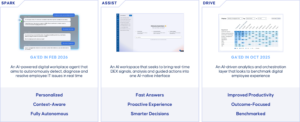
- Spark (Agentic Solution) is the autonomous agent that resolves issues directly, without human intervention.
- Assist brings real-time IT signals and guided actions into a single AI interface.
- Drive gives IT leaders visibility into how employees are adopting and benefiting from AI – a pressing question at every large company.
What Two-Minute Resolution Looks Like in Practice
The night before Nexthink’s presentation at Vista’s Annual General Meeting in April, Sam Gantner – the company’s Chief Product Officer – needed to pull the latest numbers. He opened his laptop, connected to the hotel Wi-Fi and launched Power BI. The screen showed an error. The site could not be reached.
His IT team was asleep in Switzerland. He opened Spark, took a screenshot of the error, and waited. Within seconds, Spark had diagnosed a VPN misconfiguration and offered a one-button fix. He clicked it, Power BI loaded and the entire exchange took under a minute.
Revenue Traction
After tracking the business for six years, Vista acquired Nexthink in March of 2026. AI-native recurring revenue grew from $20 million to $109 million in a single year and the company projects it will exceed $200 million and represent more than half of their revenue within two years.
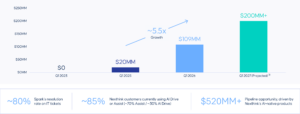
Past performance is not necessarily indicative of future results, and there can be no assurance that historical trends will continue during the life of any Vista fund or investment. Source: Nexthink as of March 2026. Any estimated and/or forecasted metrics are based on assumptions Vista believes are reasonable. Such estimates and/or forecasts are subject to a number of important risks, qualifications, limitations and exceptions. There is no assurance that such metrics will be achieved. More information on key assumptions and limitations of these estimates is available upon request. (1) Projected AI-Native ARR of $200MM+ as of Q1 2027 reflects management’s internal estimates and is subject to change based on actual business performance, market conditions, and other factors. Projected AI-Native ARR is calculated as the sum of two components: (i) anticipated expansion of ARR attributable to the Company’s existing AI product portfolio, driven by continued adoption and deepening utilization among customers currently engaged with AI-native capabilities, including Nexthink Assist and AI Drive, and (ii) anticipated incremental ARR contributions from Nexthink Spark, the Company’s autonomous IT support agent, based on management’s assumptions regarding customer adoption rates, pricing, and endpoint penetration over the forecast period.
“We knew this team for six years before we invested. That time tells you whether a team does what it says it will. Nexthink did, repeatedly.”
Rod Aliabadi
Managing Director, Vista Equity Partners
A Vision for a Personalized IT Manager for Every Employee
Pedro Bados, Nexthink’s co-founder and CEO, frames the product in deliberate terms. “Our vision for agents is as helpers,” he said in a recent interview. “We want to give a personalized IT manager to every single employee.”
That reframe matters. The conventional concern about AI in the enterprise is displacement. Nexthink’s model is additive: one IT team, capable of supporting far more people, with routine work handled automatically and complex work done by humans.
The structural case goes further. Today, Nexthink monitors the relationship between an employee and their IT environment on a roughly one-to-one basis. As organizations deploy more AI agents, that ratio shifts. A single employee may be running alongside seven, eight or nine autonomous systems simultaneously. When those agents fail, the disruption is not linear. It compounds across every agent that employee was running.
This is why the Digital Employee Experience category is increasingly foundational to the broader enterprise AI transformation story, not peripheral to it. The more AI an organization deploys, the more dependent every part of that organization becomes on the reliability of its digital infrastructure.
Vista’s thesis on Nexthink is direct: the company was acquired at a SaaS multiple. What it is becoming – the layer that keeps the agentic enterprise functioning – is worth considerably more.


Introducing Vista’s Agentic AI Factory